I started running in July with this race in mind. There were times when I admittedly wondered if this was a bridge too far; I entered July as an avid walked, but I hadn’t run over a mile since high school. I wasn’t trying to go from the couch to a 5K in nine weeks—I was aiming for 13.1 in 15m albeit with a bit of a head start in my conditioning.
My preparation was less than optimal; I had a decent base of endurance when I started running, but physiologically, my bones, joints, and muscles weren’t prepared for the strain of running, and I ended up with some nagging pains that slowed my progress.In spite of this, I’d also fallen in love with the competitive side of the sport, and a few successes in age group competition fueled a desire to enter as many races as I could: I has raced for eight consecutive weeks before taking a two week break before the half. Though I was now completing several ten mile solo runs, the constant racing probably detracted from my distance preparations, and what distance I was running in turn likely sapped some of my energy on race day.
Tapering was the smartest thing I could do. The nagging pains diminished, I felt more rested, and though the distance felt daunting, I reminded myself that the race would be like adding a 5K on to one of my ten mile Tuesday runs. I was determined to finish, even if it meant walking part of the course.
There was no conceivable way for me to hold an eight or nine minute pace for all those miles, so I set a realistic goal of finishing in around two hours and 15 minutes, roughly a ten minute pace. Psychologically, I would break the race into a series of segments rather than starting with the prospect of running for 13. I’d used similar strategies to finish century rides before when I didn’t have the benefit of drafting in a pack to good effect.
The Syracuse Half Marathon is large, professionally run race known for the generosity of its giveaways and capriciousness of the weather. The race had once been run in April until the 2016 edition was run in epic conditions—which is to say, a storm lashed the field with blinding snow, hail, and fierce winds. Character building stuff, but the organizers had the wisdom to move the race to early November, somewhat lessening the possibility of freakish meteoralogical events.
Long time residents of upstate New York may scoff at this, but the forecast for race day had us in the mid 30s with a slight chance of rain, an improvement on earlier forecasts. Whoever sacrificed what to whom was apparently successful.
 I walked to the Oncenter; city living has its benefits. The building’s main lobby and exposition area were filled with runners, vendors, officials, family members and friends. I’d expected something like this, but the experience was overwhelming. The Fleet Feet team was there in force; I managed to sneak in for a photo, but it would be another month before I met the members in earnest, and I wanted to make my way to the corral before things started in earnest.
I lined up near the 10 minute pace marker about twenty minutes before the projected start time. Runners gradually filled the corrals, but as we approached the start time, dozens, perhaps hundreds of runners were still in the Oncenter in spite of repeated calls from the officials. We set off, belatedly, after the anthem and a bit of collective cheerleading led by the organizers. The sheer size of the field meant that those of us in the slowpoke corrals had a bit of a wait before we could move, and several minutes elapsed before I tried the sensor at the start/finish line. In spite of the size of the field, I encountered no jostling or bumping.
Miles 1-3
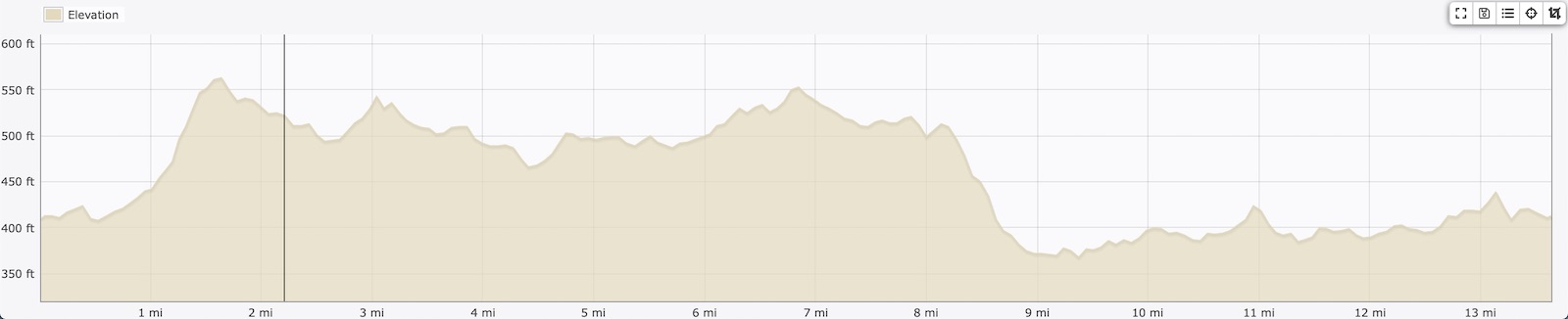
The race profile. The climbs may not have been as steep as pictured here.
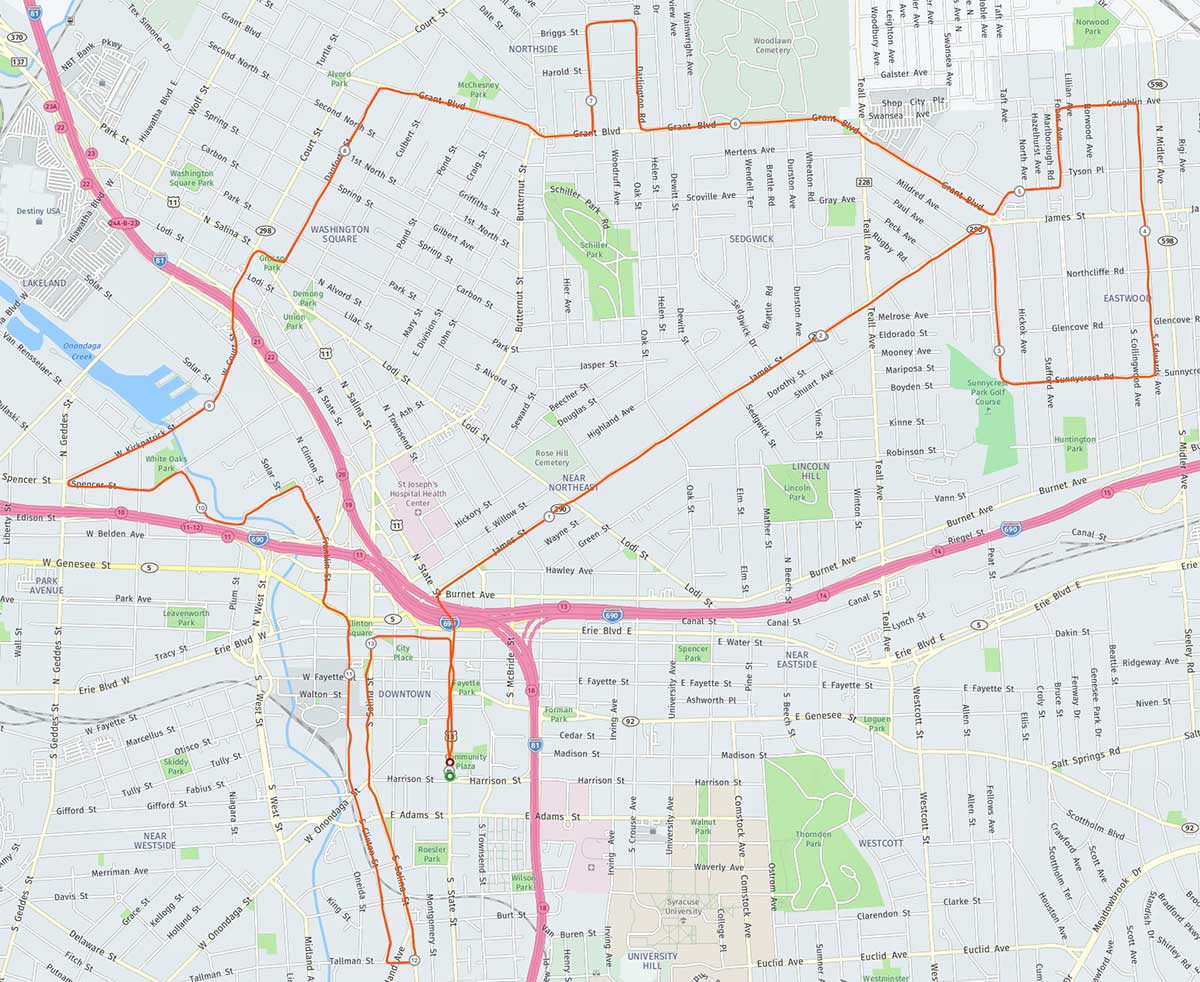
The race headed up James Street toward Eastwood, passing close to our place in Hawley Green. I was happy to see Traci standing on the side of the road ringing a cowbell as the race began the longest climb of the course, a nile long gradual climb with a few parts kicking up to 8%. A number of runners were already starting to walk at this point, but the field continued to flow up the climb, which was manageable given its location early in the race.
A brief descent brought us to Shotwell, part of the Eastwood course.
Miles 3-6
We climbed a gentle grade on Shotwell before turning onto Sunnycrest. With over 3,000 runners on the course, the field never really broke up even as we worked our way through the rolling streets in Eastwood. Clusters off and cheered us through Eastwood. Some had signs; I chuckled when I saw “Go, Random Stranger.” Another read, “Remember, You Paid to Do This.”
Fair point.
I’d felt good, dare I say cheerful, for most of the race so far. My strategy of “chunking” the race into 5K segments was sound, and I had a sense early on that I could keep my pace going.
We climbed another hill on Coughlan and Forbes before heading for the long stretch on Grant. It was here that it happened: the marker at mile 5 wreaked havoc on my strategy, or perhaps it’s more accurate to say that I made the mistake of thinking about what I had yet to overcome rather than what I’d accomplished. This was a harbinger of the mid-race doldrums yet to come.
Miles 6-9
The first segment of the course on Grant passed the scenic, expansive Woodlawn Cemetery. I crossed the 10K sensor with a time of 1:04:23 and I took down a gel. The race took a turn up Darlington through a residential neighborhood to Briggs, which hit us with a short climb before returning to Grant via Wadsworth.
My gel wasn’t enough; fortunately, the next aid station at mile 7.5 had Gu, which was just enough.
I was ticking down the miles at this point. I was starting to tire, but the real strain was more psychological. It helped to have so many runners around me, but mile markers didn’t seem to come quickly enough and my pace started to drop.
I thought about the sign in Eastwood—I had indeed paid to do this. At least the jacket was nice . . .
Fortunately, the descent on Danforth and Court streets gave us a boost as we approach the inner harbor.
The Final Miles
We were now running through an industrial area, a combination of undeveloped plots and warehouses the seemed to stretch interminably. I grabbed a second Gu at an aid station by the inner harbor to ensure that I had enough carbs for the finish. I still had hopes of being able to pick things up in the final mile, though my legs suggested that this might not be the case.
An attractive steel bridge brought us across Onondaga Creek into Franklin Square, an attractive and recognizable neighborhood, and while the pain was increasing, I knew we were in the last three miles of the race.
We ran south, through Armory Square, on Clinton before the course brought us back through the city, where clusters of fans began cheering us on.
The right turn on to State bought us back to the finish line; the finishing banner was a welcome sight, and while I didn’t have the energy for accelerate in the final three miles, I had just enough left for a final push to the finish. I was happy to see Traci waiting for me as I ran to the finish line and collected my medal.
I crossed the line with a gun time of 2:17:55. My net time of 2:15:28 was close to my target.
Postrace
Traci and I went back into the Oncenter to explore the vendors and grab my post race meal. Bands played, results came up on the screens, and thousands made their way past event booths. I bought up a jacket at the CNYRacing booth, Traci picked up a few things, and we made our way back to her car. I was exhausted, but the post race endorphin rush reminded me of why I’d subjected myself to this.
I’d been running for less than four months, but I’d finished a half marathon, and there were more races to come.
CNYRacing provided the giveaway jacket and finisher’s medal. Both are exceptionally good. The finisher’s medal is a thick, two-sided medallion with a built in stand. Racers were provided with a safe, closed course and had the option of having 5, 10, and 15k times sent to family and friends courtesy of Leone Timing. There were a number of aid stations, with several providing gels after the mid point. The postface food was varied and plentiful, and the live bands added a festive touch.
Location: Oncenter. Syracuse, NY
Cost: $105 (Race costs less with early registration)
Swag: Jacket, medal, expo, post race food
Events: Half marathon
Field: 3166
Result: 1867/3166@2:17:55; 10:32; 85/129


