Competitive cyclists quickly learn about the miracle of the draft—or they ride lonely time trials for 40 miles. This makes the sport tactically complex, because the strongest, fastest riders often lose due to the vast advantages conferred by riding in the slipstream, where riders typically save 30% of their energy. A pack is like a flight of Geese, and when riders work well together, a pace line becomes a thing of beautiful efficiency—and extreme danger.
Cycling could thus be described as collective individualism, a paradox, a sport where competitors work in poetic synchronicity until the final mile, where riders position themselves like chess pieces to set up the final sprint.
Tactically, I’ve found running to be very different. Drafting certainly plays a role, but it isn’t the same, particularly at my leisurely pace, as following a wheel at 25mph. That said, my best time have usually come when I’ve had runners to chase or compete with, so the presence of others, particularly those closely matched, has given me a boost even if most of my races have involved solitary efforts.
I began to appreciate running’s social aspects when I joined some of the Cold Feet winter runs out of our local Fleet Feet. One aspect of running that I stand to struggle with, at least at high speeds, is maintaining a consistent pace; it’s far easier to keep a consistent speed with a group, and psychologically, having others around on a long run can be motivating.
The Cold Feet runs provided me with structured distance training, and it was on one such run that I met Carolyn, a fellow educator at a local college. I was looking for something a little shorter than the planed run, she was looking for the same, so we joined up for an 8 mile run.
Our conversation ranged from academics to running; I told her that I was tapering for the Lake Effect. She had signed up for the same event but was on the fence, as work had cut into her running time. I didn’t relish the idea of running 13.1 cold miles alone, so I offered to run with her if she wanted to run in the event.
I’m not a fast distance runner. I’m really not a fast runner period, but I realistically have no hope of placing in my age group in a half. There was also the issue of lost training time. I was finally healthy after a month of fighting the aftermaths of bronchitis, followed by a nasty intestinal bug. I hadn’t really lost fitness, but though I’d gotten in a couple of longer runs, I really hadn’t been able to put on as many miles as I wanted to, so the opportunity to have a companion for the duration of the race was appealing.
Lake Effect Half Marathon
Onondaga Lake Park serves as the venue for the Lake Effect Half Marathon, which kicks off central New York’s distance running season. As with so many local races, the event takes advantage of Onondaga Lake Park’s “wheel” trail, which is effectively a two-lane road. The course starts near the Salt Museum, follows the parkway past Willow Bay and Long Branch before turning around near the dog park near Route 370 and heading back, past the start line to the loop near the playground in Liverpool. Runners then repeat this a second time.

Approaching the final loop. Photo by Maverick Events.
This would be my fifth race in the park. I was quite familiar with most of the course, which was fast, flat, and exposed to the winter winds.
Carolyn and I met up at the heated tent set up near the Salt Museum, perused the CNYRacing merchandise tent (they are the outfit responsible for the wonderful shirts, jackets, and medals we receive at many of the local events), and sheltered in the tent.
There was a cold breeze off the lake; snow still covered the ground, but the temperatures held in the mid 30s. Those of us who contended with the snow on the parkway during Cupid’s Chase were happy to see the asphalt completely clear of snow.
Roughly 700 of us set off along the parkway—in addition to the 500 half marathoners, about 200 were running in the quarter marathon, which is a relatively recent addition to the event. We had no strategy in mind beyond finishing the event and having a good time in the process. We settled into a 10:30 pace.
So. Much. Creekwalk.
The miles rolled by smoothly. The runners in our part of the field we cruising along as well, talking to each other, and generally taking the experience in. Carolyn and I made a few sardonic remarks about the mile markers, which reflecting the multi-lap nature of the course, gave contradictory numbers.
Onondaga Lake Park is rightfully called the Central Park of central New York, It’s a truly beautiful park, and we’re lucky to have it. That being said, running up and down a trail I’d raced on so often started to get a little monotonous. Once again, I was glad for Carolyn’s company as we traversed the course a second time.

Entering the second circle of hell. Photo by Maverick Events.
It was around the sixth mile that I entered the dead zone—the no-man’s land of the race, The miles seemed to drag on, though my pace was comfortable. We were both getting a little winded and talking less.
The mile markers seemed a little more cruel now, since they marked both the first and third legs of the course. I think we both muttered a bit when we saw mile “1” not long after we passed the seven mile mark seven mile mark—this was a product of the multi-lap nature of the course, but it was a little discouraging to see the lower number. We contented ourselves by cursing the signs.

The expressions on the faces of the finishers ahead of us pretty much sum up how we felt. Photo by Maverick Events.
We were both feeling worn as we headed toward the feed zone near the dog park at the northern end of the course, but on the bright side, that meant we had a little over three miles to go. Another 5K, and we’d be done. There was no preternatural infusion of energy at the point, but the end, while not in sight, was approaching fast.
But not too fast. We were still running around a 10:30. pace.
We were dong about that when we passed the finish line to complete the final loop near the playground. We dubbed it the circle of hell. The stretch was about a third of a mile, but at this stage of the race every yard stretched further and further.
We had just enough endurance left to pick up the pace a bit. The runners who finished just ahead of us had a touching moment when they crossed the finish line with clasped hands.
I finished with a time of 2:22:09.

And done. Photo by Maverick Events.
Both of us were gassed by the end of the race. I was happy for the company, and having a partner led to a steady pace and a distraction when the course started to feel monotonous.
Half marathon #2 was in the books. As I said before, this isn’t really my preferred distance, but this was the first of the four I’d signed up for in April and May. Three would take place over two week intervals that would take me to Ithaca, Albany, and Pittsburgh.
Needless to say, Covid-19 shattered those plans.
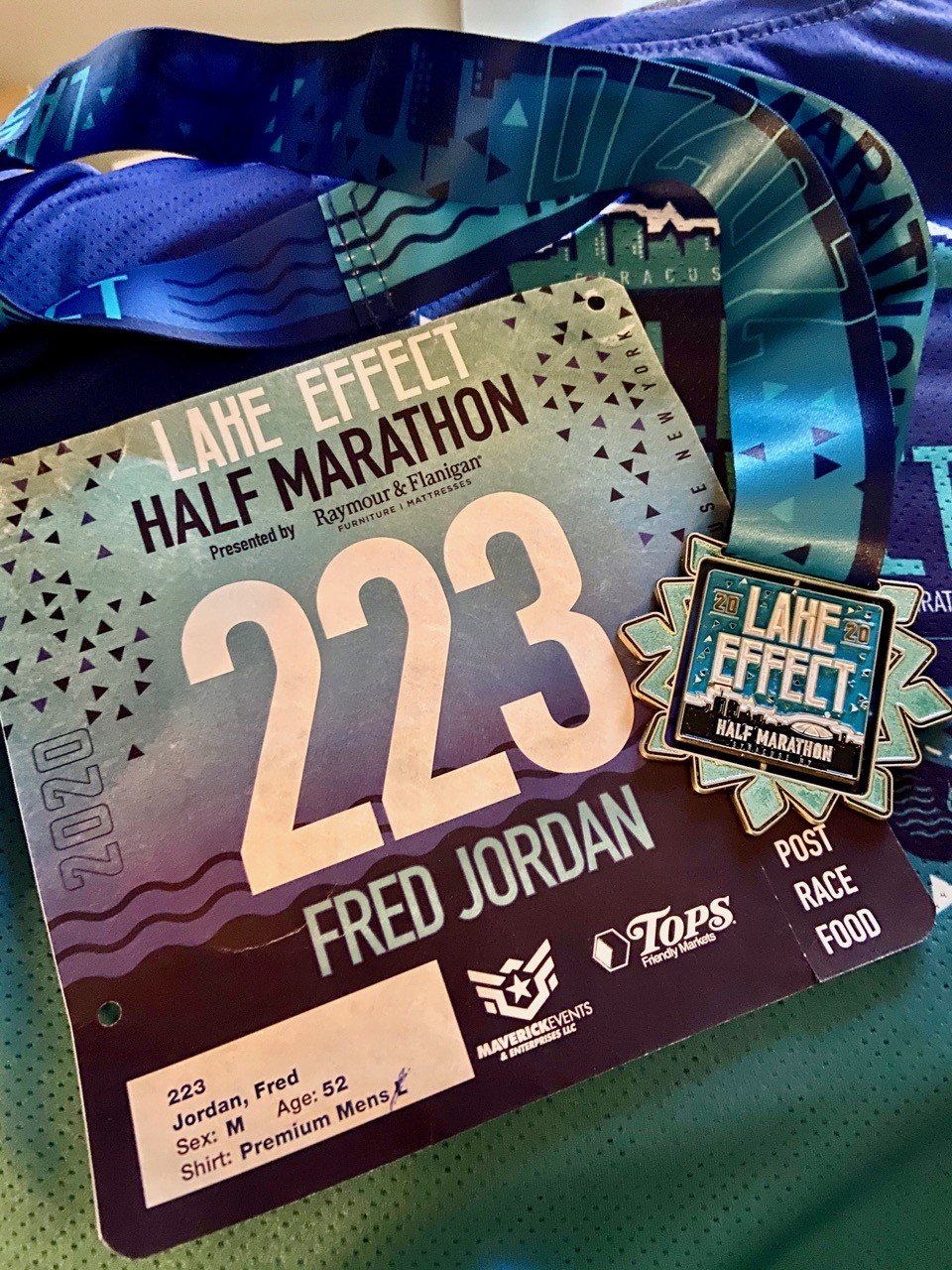
I’m a fan of cool, winter color schemes. Another beautiful shirt and medal, courtesy of CNYRacing.
We were treated to plenty of post-race food in the heated tent at the finish. As with some other races, we had the opportunity to look up our results on computers situated in the tent, and of course there was the wonderful CNYRacing text with the beautiful clothing. I splurged on a hooded shirt.
The race was well organized, the course safe and familiar. While “parkway” fatigue is real, having access to a large, car-free space with enough room to accommodate mid-sized races is a blessing, and the views of the lake make this a scenic venue—even if we ran up and down the parkway four times.
The winter color scheme was beautiful; I’m a fan of cooler tones, and the matching bib, medal, and shirt were beautiful. The shirt, a long sleeve design made out of technical material and boasting thumbholes, is a great training companion. We had a nice selection of food at the end of the race, and the free photographs are much appreciated.

Location: Onondaga Lake Park
Cost: $70
Swag: Shirt, medal, food , photographs
Events: Quarter and half marathons
Field: Half marathon: 475
Result: 354/475@2:22:09; 10:52; 20/28
Shoe: Hoka Rincon


