Le Moyne’s spring break started on March 6. Tipp Hill and the Pi Day race served as bookends for my break, but I would eventually finish the semester using Zoom and Canvas and the races were the last I would run during the “old normal.” Covid-19 changed everything that quickly.
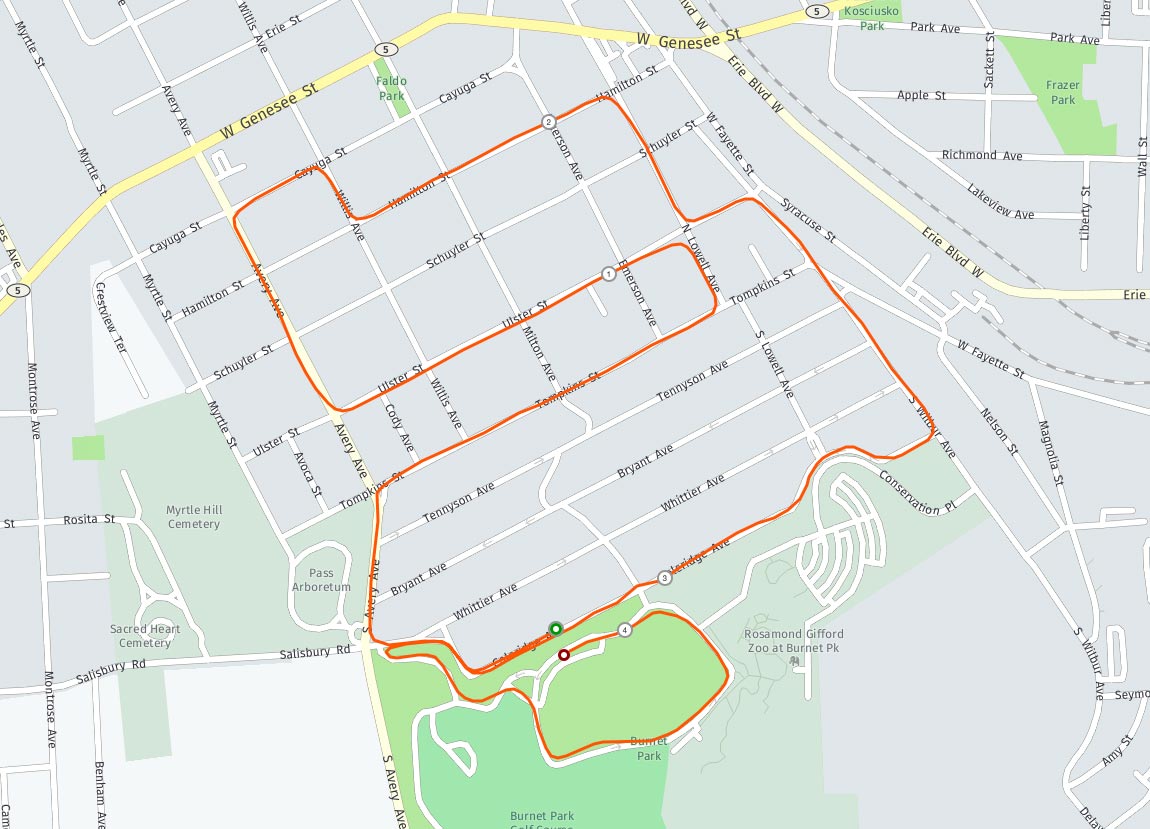
The Tipperary Hill Shamrock Run is the first race of Syracuse’s Syrathon series and for runners and walkers who eschewed the winter races, the official start of race season. The event’s four-mile course traces a path through Syracuse’s Tipperary Hill neighborhood, past Irish bars and pubs and Tipp Hill’s unique stop light with the green on top. It’s a fun, festive event with enthusiastic spectators, bands and music, unofficial aid stations, and a couple of climbs to remind you that this is a challenging course.
March in central New York is a capricious month, bringing with it the possibility of 70 degree weather or thirty inches of snow. Despite this, or perhaps because of it, the Shamrock Run has grown into one of the region’s largest events, attracting thousands of runners longing for a shot at a win or a chance to put a few down at a local pub after the race—though many choose to get a head start on this out on the course.
Race day was chilly and windy but otherwise devoid of memorable weather. With parking at a premium and 3,000 preregistered, Traci and I opted to park early in the Rosamand Gifford Zoo lot at Burnet Park and hope to find shelter from the wind. Registration and a sizable expo were situated in a large building that, while unheated, gave runners a decent amount of space and shelter.
We lined up on Coleridge Avenue for the start. I positioned myself at the 8:00 pace with some other Fleet Feet runners in advance of the race. Syracuse Mayor Ben Walsh addressed the horde of walkers and runners, Fleet Feet owner Ed Griffith was honored by the race organizers, and after the anthem, a mass of runners began their trek, though due to the sheer size of the field, it was a number of seconds before the runners around me could move.

The opening descent is a photographer’s dream. I’m in this photo. Honestly.
Most of the first mile of the race consists of an oft-photographed downhill stretch on Coleridge, Whittier, and South Avery. There was the inevitable jostling and jockeying for position in the opening meters, but most of the runners comported themselves well; we enjoyed the spectacle of the field and the long descent on Avery and Tompkins, We passed the “reversed traffic light,” were serenaded with music and bands as we passed Stonethrowers and Coleman’s, and soaked in the neighborhood’s quirky, festive atmosphere.

Rounding the corner on Coleridge.
The first climb on Ulster briefly dampened the mood, but some enthusiastic residents and music from the Blarney Stone helped to restore our spirits. A few of the runners around me took advantage of various forms of liquid fortification offered by the locals. This is still a new concept for me though I’ve seen it at other events—alcohol and bike racing doesn’t mix nearly as well (or legally), but while I didn’t partake myself, I had a couple of chuckles. We could periodically catch glimpses of the leaders as we weaved through the streets, and we knew we weren’t racing for awards at the point.
I have no idea what aid stations will look like in our new normal, but I don’t see too many runners and walkers taking cups of beer or shots of Fireball from strangers anytime soon.

Mid-race, before the final climb.
A short, steep descent on Hamilton marked the midpoint of the race, and I was holding my own. We had a bit of respite from the hills and rollers as we turned past Nibsy’s and headed up North Wilbur to begin a long, steady climb. Most of mile three was uphill; I maintained a decent tempo, but I was paying dearly for it by the time we headed back up Coleridge. The consolation was that I caught a fair number of runners before the end of the climb.
The final mile had a few small rollers, the the final run to the finish line in the park was fast in spite of the number of competitors making their way to the end. I finished with a time of 34:01, under the 35 minutes I was aiming for. My net time was 33:29. Those of us at the 8:00 flag 30 second price not moving further up, but as with the Wonderful Run, I can’t fault organizers for this, not with a field this large.
My net pace of 8:23 wasn’t too far off my better 5K paces, so the suffering on the course paid off. But it didn’t stop at the finish line.
I went back to the expo for some food and to wait for Traci. By the time she arrived, the lower back pain that was just noticeable at the finish was announcing itself in a big way at the expo. I’d done some hill and stair work on Mount Olympus and Thornden Park over the winter, but my recent speed work with a group at Onondaga Lake Part involved fast workouts on the flats. My guess is that my relatively high pace (for me) up the final climb put an unfamiliar strain on my legs and back for which I was unprepared.
That aside, we enjoyed the expo, downed copious quantities of chocolate milk and bagels, and called it a day.
It may be some time before we see of this size again. I’m glad we could take part in this large, quirky, challenging event just days before the restrictions began and the world changed. Runners and walkers looking for a spectacle with loads of music, atmosphere, and post race Guinness should add this to the calendar—just be prepared to work for it.

Location: Burnet Park, Syracuse
Cost: $25
Swag: Shirt, food, expo
Events: 4 mile race
Field: 2939
Result: 476/2939@34:01; 8:31; 22/116
Shoe: Cavu 2


